Vibrating mirrors of light create analog of a black hole event horizon
Vibrating mirrors of light create analog of a black hole event horizon
Vibrating mirrors of light create analog of a black hole event horizon
Key points
اہم نکات
मुख्य बातें
- Physicists at the University of California, Santa Barbara have built a laboratory system that mimics the event horizon of a black hole, using vibrating sheets of light instead of real mirrors.
- The team cooled lithium atoms to near absolute zero and trapped them between two sheets of laser light that acted as mirrors.
- When one light sheet was vibrated about 100 times a second, the diffuse cloud of atoms bunched into a tight packet moving in one direction, the same one-way flow that light follows near a black hole's event horizon, from which nothing can escape.
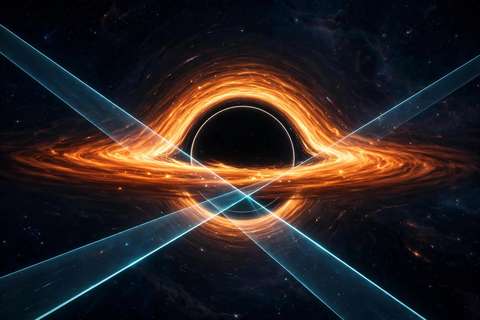
Physicists at the University of California, Santa Barbara have built a laboratory system that mimics the event horizon of a black hole, using vibrating sheets of light instead of real mirrors. The team cooled lithium atoms to near absolute zero and trapped them between two sheets of laser light that acted as mirrors. When one light sheet was vibrated about 100 times a second, the diffuse cloud of atoms bunched into a tight packet moving in one direction, the same one-way flow that light follows near a black hole's event horizon, from which nothing can escape. The work, published in Physical Review Letters, gives researchers a controlled way to study how waves behave near horizons, a regime that cannot be tested with real black holes.
Physicists at the University of California, Santa Barbara have built a laboratory system that mimics the event horizon of a black hole, using vibrating sheets of light instead of real mirrors. The team cooled lithium atoms to near absolute zero and trapped them between two sheets of laser light that acted as mirrors. When one light sheet was vibrated about 100 times a second, the diffuse cloud of atoms bunched into a tight packet moving in one direction, the same one-way flow that light follows near a black hole's event horizon, from which nothing can escape. The work, published in Physical Review Letters, gives researchers a controlled way to study how waves behave near horizons, a regime that cannot be tested with real black holes.
Physicists at the University of California, Santa Barbara have built a laboratory system that mimics the event horizon of a black hole, using vibrating sheets of light instead of real mirrors. The team cooled lithium atoms to near absolute zero and trapped them between two sheets of laser light that acted as mirrors. When one light sheet was vibrated about 100 times a second, the diffuse cloud of atoms bunched into a tight packet moving in one direction, the same one-way flow that light follows near a black hole's event horizon, from which nothing can escape. The work, published in Physical Review Letters, gives researchers a controlled way to study how waves behave near horizons, a regime that cannot be tested with real black holes.
Most read
سب سے زیادہ پڑھی گئی
सबसे ज़्यादा पढ़ी गई
- Loading...
Get news in your inbox
خبریں اپنے ان باکس میں حاصل کریں
खबरें अपने इनबॉक्स में पाएं
One email when new stories are published. No spam, unsubscribe anytime.
نئی خبریں شائع ہونے پر ایک ای میل۔ کوئی سپیم نہیں، کسی بھی وقت ان سبسکرائب کریں۔
नई खबरें प्रकाशित होने पर एक ईमेल। कोई स्पैम नहीं, कभी भी अनसब्सक्राइब करें।